EDUCAÇÃO PARA A SUSTENTABILIDADE EM ARQUITETURA E URBANISMO
UM ESTUDO DE CASO NA UNIVERSIDADE TIRADENTES, SE
DOI:
https://doi.org/10.35572/arql.v4i13.7291Palavras-chave:
Arquitetura Sustentável, Educação Ambiental, Sustentabilidade socioambientalResumo
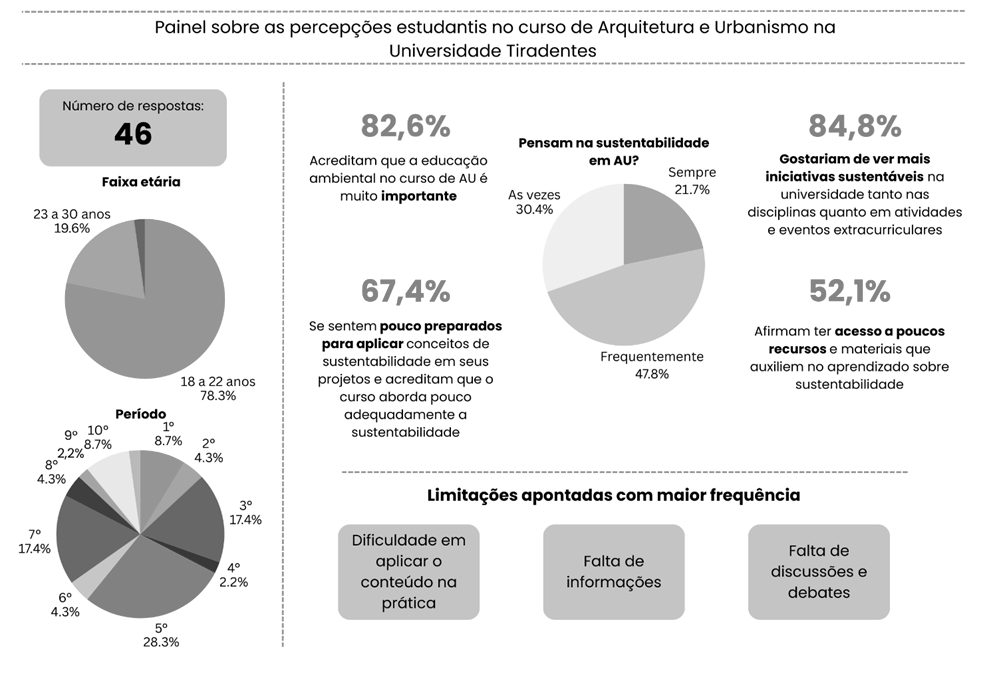
Este artigo relata as percepções de estudantes de Arquitetura e Urbanismo da Universidade Tiradentes (UNIT) sobre a sustentabilidade em sua formação acadêmica. A pesquisa, de caráter exploratório e descritivo, utilizou revisão bibliográfica, análise documental do Plano Pedagógico de Curso (PPC) e aplicação de questionário eletrônico a 46 discentes, com abordagem metodológica mista (qualitativa e quantitativa). Os resultados revelaram que, embora quase metade das disciplinas do curso trate da sustentabilidade, o tema ainda é abordado de forma fragmentada e com pouca transversalidade. Os estudantes reconhecem sua importância, mas apontam dificuldades como superficialidade das discussões, ausência de interdisciplinaridade e escassez de práticas concretas. As análises qualitativas reforçaram a demanda por maior integração curricular, recursos didáticos e experiências reais, como oficinas e visitas técnicas. Conclui-se que o tema está em consolidação na UNIT, mas requer reestruturação pedagógica para se tornar eixo estruturante da formação, integrando teoria e prática e ampliando a vivência discente.
Downloads
Referências
AVEZUM, André Luís. Arquitetura ecológica e tecnologia no século XX: base para o projeto arquitetônico sustentável. Dissertação (Mestrado de Arquitetura e Urbanismo) Universidade de São Paulo- USP. São Paulo: 2007.
AZMAT, F.; SURI, H.; WATTY, K. The integration of the Sustainable Development Goals into curricula, research and partnerships in higher education. International Review of Education, 2019. Disponível em: https://link.springer.com/article/10.1007/s11159-019-09787-0. Acesso em: 18 jul. 2024;
BARDIN, Laurence. Análise de conteúdo. São Paulo: Edições 70, 2016;
BERNARDI, Tiago Costa. Arquitetura Neocolonial e “as sábias lições” de José Marianno Filho. 2014. 45 f. Monografia - Curso de História, Universidade Federal Rural do Rio de Janeiro, Nova Iguaçu.
BLUMENSCHEIN, Raquel Naves. A Sustentabilidade na Cadeia Produtiva da Indústria da Construção. 2004. Tese (Doutorado) Universidade de Brasília - Centro de Desenvolvimento Sustentável. Brasília.
BRASIL. Ministério da Educação. Resolução nº 2, de 15 de junho de 2012. Diretrizes Curriculares Nacionais para a Educação Ambiental. Diário Oficial da União nº 116. Brasília, DF, de 18 jun. 2012. Seção 1, p. 70-71;
BRASIL. Lei 9.795, de 27 de abril de 1999. Dispõe sobre Educação Ambiental e institui a Política Nacional de Educação Ambiental, e dá outras providências. Brasília, DF, 1999.
BRASIL. Ministério do Desenvolvimento Regional. MDR apresenta os 16 Objetivos do Desenvolvimento Urbano Sustentável (ODUS). Brasília, DF, 7 dez. 2021. Disponível em: https://www.gov.br/mdr/pt-br/noticias/mdr-apresenta-os-16-objetivos-do-desenvolvimento-urbano-sustentavel-odus. Acesso em: 22 mar. 2026.
BRASIL. Resolução CNE/CES n. 1, de 11 de julho de 2025. Institui as Diretrizes Curriculares Nacionais do Curso de Graduação em Arquitetura e Urbanismo. Diário Oficial da União: seção 1, Brasília, DF, p. 36-39, 14 jul. 2025. Disponível em: https://www.gov.br/mec/pt-br/cne/pdf/normas-classificadas-por-assunto/diretrizes-curriculares-cursos-de-graduacao/rces001_25.pdf Acesso em: 22 mar. 2026.
DIAS, S. B. A. O estado da arte sobre as pesquisas brasileiras que relacionam a Educação Ambiental com a Arquitetura e Urbanismo. Revista de Ensino de Ciências e Matemática, v. 11, n. 2, p. 190-206, 2020.
DOURADO, Brenda Milhomem. Sobre o ensino da Sustentabilidade Ambiental nos cursos de Arquitetura e Urbanismo: avaliação e subsídios. 2015. 233 f. Dissertação (Mestrado) - Programa de Pesquisa e Pós-Graduação, Universidade de Brasília, Brasília.
GOMES, Carla Pinheiro; LEITE, Guilherme Urquisa; SENA, Rafael Wandson Rocha; ANDRADE, Elysson Marcks Gonçalves de. Impacto Ambiental e Gerenciamento de Resíduos Sólidos Advindos da Construção Civil no Brasil: Uma Revisão de Literatura. Rev. Mult. Psic., vol.15, n.55, p. 729-742, mai., 2021. Disponível em: https://idonline.emnuvens.com.br/id/article/view/3108 Acesso em: 19 fev. 2025;
GONÇALVES, Vanessa Vidal Magalhães; VITAL, Giovanna Damis. Panorama do ensino de arquitetura e urbanismo no Brasil: desafios sob uma perspectiva sistêmica. Revista Observatorio de la Economía Latinoamericana, Curitiba, v.21, n.11, p. 20963-20982, nov. 2023. Disponível em: https://ojs.observatoriolatinoamericano.com/ojs/index.php/olel/article/view/2208 Acesso em: 27 abr. 2025.
GRAFF, Paula Adjunto Martins; GÓES, Thiago Montenegro. Análise da demanda do estudo em sustentabilidade e o impacto na vida de profissionais pós REABILITA. Paranoá, [S. l.], v. 14, n. 30, mai. 2021.Disponível em: https://periodicos.unb.br/index.php/paranoa/article/view/35086 Acesso em: 27 out. 2024;
GUERRA, Antonio Fernando Silveira. Ambientalização e sustentabilidade nas universidades: subsídios, relfexões e aprendizagens. Itajaí, SC: UNIVALI, 2015.
LOPES, José Sérgio Leite. Sobre Processos de "Ambientalização" dos Conflitos e Sobre Dilemas da Participação. Horizontes Antropológicos, Porto Alegre, ano 12, n. 25, p. 31-64, jan./jun. 2006.
MERRILL, M. Y.; SAMMALISTO, K.; CEULEMANS, K.; LOZANO, F. J. Connecting Competences and Pedagogical Approaches for Sustainable Development in Higher Education: A Literature Review and Framework Proposal. Sustainability, v. 9, n. 10, p. 1889, 2017. Disponível em: https://www.mdpi.com/2071-1050/9/10/1889 Acesso em: 18 jul. 2024.
ORGANIZAÇÃO DAS NAÇÕES UNIDAS (ONU). Transformando Nosso Mundo: A Agenda 2030 para o Desenvolvimento Sustentável. Nova York, 2015. Disponível em: https://sdgs.un.org/2030agenda Acesso em: 18 jul. 2024.
ORGANIZAÇÃO DAS NAÇÕES UNIDAS (ONU). Objetivo de Desenvolvimento Sustentável 11: cidades e comunidades sustentáveis. [S. l.], [2026?]. Disponível em: https://brasil.un.org/pt-br/sdgs/11. Acesso em: 22 mar. 2026.
OTERO, E. V., et al. Desenvolvimento urbano sustentável: produção e qualificação do ambiente construído no Brasil. Universidade de São Paulo. Faculdade de Arquitetura e Urbanismo, 2023.
SCHERER, Paula; MASUTTI, Mariela Camargo. A Sustentabilidade Ambiental Inserida no Curso de Arquitetura e Urbanismo. XXIII Seminário Interinstitucional de Ensino, Pesquisa e Extensão, Cruz Alta/RS, p. 1-12, out. 2018. Disponível em: https://www.studocu.com/pt-br/document/uniesp-centro-universitario/arquittura/a-sustentabilidade-ambiental-inserida-no-curso-de-arquitetura-e-urbanismo/76243247 Acesso em: 27 out. 2024.
SHIMBO, L. Z. Sustentabilidade em arquitetura e urbanismo: uma atualização após a Covid-19. Metrópole e pandemia: presente e futuro. Rio de Janeiro: Letra Capital, 2022;
UNCED. Conferência das Nações Unidas para o Meio Ambiente e o Desenvolvimento. Agenda 21. 1992;
VILLELA, Dianna Santiago. A Sustentabilidade na Formação Atual do Arquiteto e Urbanista. Dissertação de Mestrado - Universidade Federal de Minas Gerais. Belo Horizonte, 2007;
YIN, Robert K. Estudo de caso: planejamento e métodos. Tradução de Cristhian Matheus Herrera. 5. ed. Porto Alegre: Bookman, 2015.
Downloads
Publicado
Como Citar
Edição
Seção
Licença
Copyright (c) 2026 Millena Moreira Fontes, Júlia Machado Soares

Este trabalho está licenciado sob uma licença Creative Commons Attribution-NonCommercial-NoDerivatives 4.0 International License.
Autores que publicam nesta revista concordam com os seguintes termos:
1. Autores mantém os direitos autorais e concedem à revista o direito de primeira publicação, com o trabalho simultaneamente licenciado sob a Licença Creative Commons Attribution-NonCommercial-NoDerivatives 4.0 que permite o compartilhamento do trabalho com reconhecimento da autoria e publicação inicial nesta revista;
2. Autores têm autorização para assumir contratos adicionais separadamente, para distribuição não-exclusiva da versão do trabalho publicada nesta revista (ex.: publicar em repositório institucional ou como capítulo de livro), com reconhecimento de autoria e publicação inicial nesta revista;
3. Autores têm permissão e são estimulados a publicar e distribuir seu trabalho online (ex.: em repositórios institucionais ou na sua página pessoal) desde que concluído o processo editorial, já que isso pode gerar alterações produtivas, bem como aumentar o impacto e a citação do trabalho publicado (Veja O Efeito do Acesso Livre);
4. Não recomenda-se publicação e distribuição do artigo antes de sua publicação, pois isso poderá interferir na sua avaliação cega pelos pares.