THE LIGHTNESS OF CONCRETE
THE ARCHITECTURE OF THE CHURCH OF SÃO BONIFÁCIO IN SÃO PAULO. HANS BROOS.1964-1966
DOI:
https://doi.org/10.35572/arql.v4i15.7778Keywords:
religious architecture, architectural projects, brutalism, Hans BroosAbstract
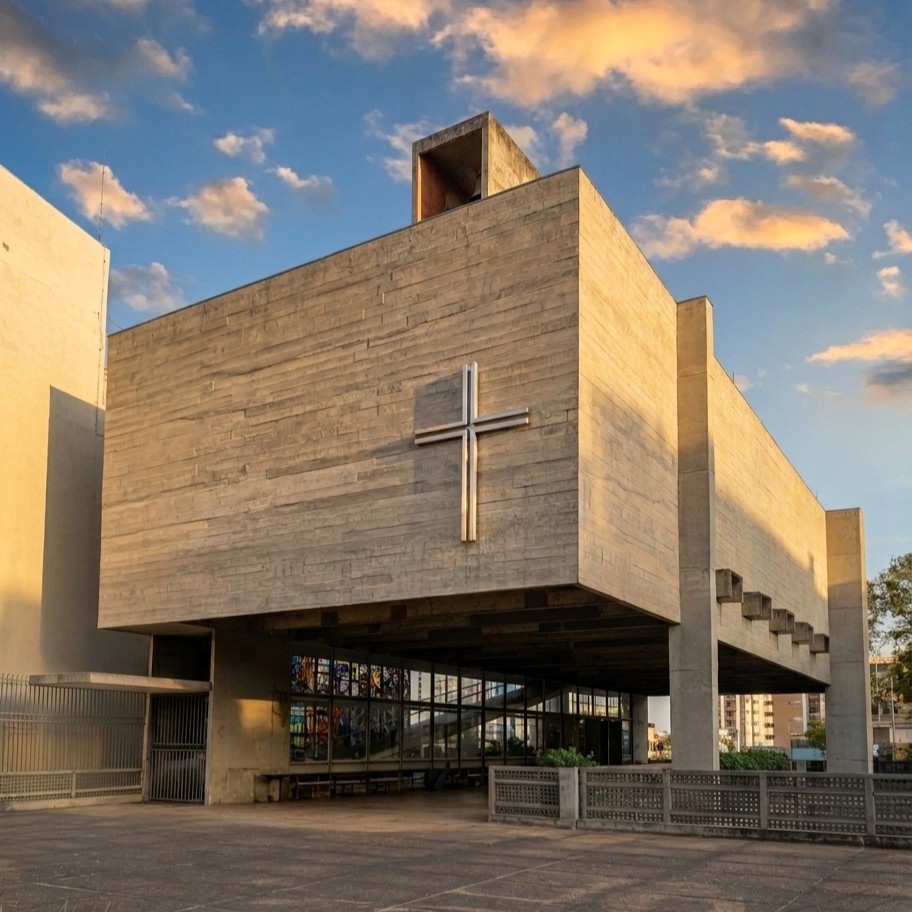
Located in Vila Mariana, in São Paulo, the Church of São Bonifácio is a landmark of Brazilian brutalist architecture. Designed between 1964 and 1966 by the Slovakian-Brazilian architect Hans Broos (1921-2011) for the German community, the building marked the architect's debut in the capital of São Paulo with the use of exposed concrete. The work ostensibly revealed the rustic marks of the wooden formwork, an innovation that earned Broos the Rino Levi Award from the IAB-SP in 1967 and featured in the biennial award of the IAB in 1968.
In this essay, it will be focused - in addition to some images that contextualize the volumetry of the Church, only its interior, with the architectural solutions, which make a dialogue with the form and function, and the constructive issues of the brutalist tectonics, resulting in a space rich in plastic, and religious introspection, by the subtlety of the indirect light that bathes the nave and the beautiful concrete panel that enriches the composition, as will be seen in the images.
Downloads
References
DAUFENBACH, Karine. A modernidade em Hans Broos. São Paulo: Annablume.2021.
SERRAGLIO, João Paulo. Arquitetura como tempo: Hans Broos e o Brasil. São Paulo: tese de doutorado em Arquitetura e Urbanismo . FAUUSP. 2025
Downloads
Published
How to Cite
Issue
Section
License
Copyright (c) 2026 Alcilia Afonso

This work is licensed under a Creative Commons Attribution-NonCommercial-NoDerivatives 4.0 International License.
Authors who publish in this journal agree to the following terms:
1. Authors retain the copyright and grant the journal the right of first publication, with the article simultaneously licensed under the Creative Commons Attribution License BY NC ND, which allows the sharing of article with acknowledgment of authorship and initial publication in this journal;
2. Authors are authorized to take additional contracts separately, for non-exclusive distribution of version of the article published in this journal (e.g. publish in institutional repository or as a book chapter), with acknowledgment of authorship and initial publication in this journal;
3. Authors are allowed and encouraged to publish and distribute their research work online (e.g. in institutional repositories or on their personal page) once the editorial process has been completed, as this can generate productive changes, as well as increase the impact and the citation of published article (See The Effect of Open Access);
4. It is not recommended to publish and distribute the article before its publication, as this may interfere with its blind peer review.