A PROPOSAL FOR A GRAPHICAL ANALYSIS OF ARCHITECTURAL MATERIALITY
CASE STUDY OF THE SAN JOSÉ BUILDING
DOI:
https://doi.org/10.35572/arql.v4i14.7430Keywords:
materiality, contemporary architecture, projects analysis methodAbstract
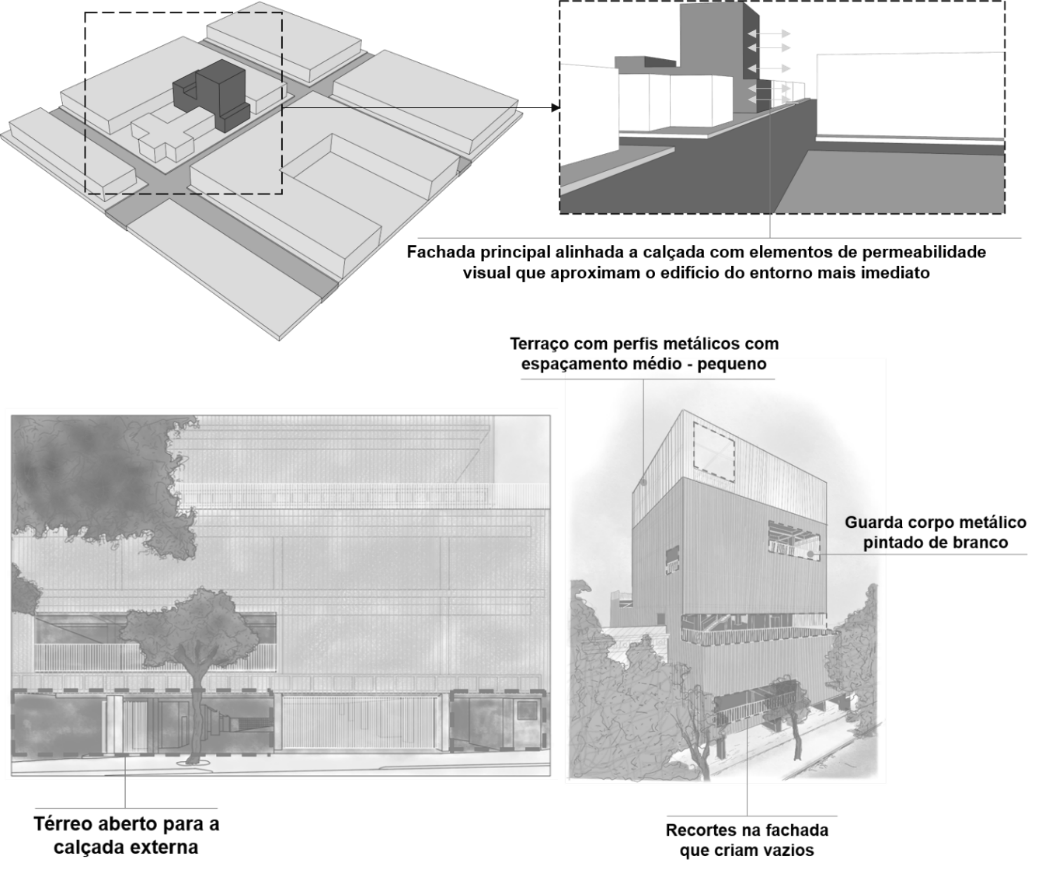
The advances in materials technology expand the technical and aesthetic possibilities of architectural production. However, there are still difficulties in discussing architectural materiality through project analysis. This raises the question: How can architectural materiality be reflected upon in the formal analysis of architecture? The aim is to debate the creation of relevant analytical categories that discuss architectural materiality. Accordingly, three analytical categories are proposed: (1) characterization of material properties and their use in architectural form; (2) texture and coloration of construction elements; (3) the relationship of solid and void in architecture through materials. The method is applied to the Estación San José Building in Mexico, where the use of exposed concrete and perforated metal panels highlights the formal expressiveness of the building. The tool allows the creation of analysis sheets with a qualitative approach that highlights the relationship between the performance of materials and their plastic potential in architectural form, aiding in the interpretation of constructive solutions in the design process.
Downloads
References
BARREDO H.; LASSANCE, G. Análise gráfica, uma questão de síntese: a hermenêutica no ateliê de projeto. Arquitextos, São Paulo, v.133, 9 p., 2011. Disponível em: https://vitruvius.com.br/revistas/read/arquitextos/12.133/3921. Acesso em: 28 fev. 2025.
BAUER, L. A. F. Materiais de construção. 6 ed. Rio de Janeiro: LTC, 2019.
BUSWELL, R. A.; LEAL DE SILVA, W. R.; JONES, S. Z.; DIRRENBERGER, J. Robotic micro-house: experience with 3D concrete printing for housing construction. In: Proceedings of the International Conference on Progress in Additive Manufacturing (Pro-AM 2022). Singapore: Springer, 2023. p. 17–30.
CHING, F. Arquitetura de interiores ilustrada. São Paulo, Bookman, 2006.
CHING, F. Arquitetura. Forma, Espaço e Ordem. São Paulo: Martins Fontes, 1998.
CLARK, R. H.; PAUSE, M. Arquitectura: temas de composición. Barcelona: Editorial Gustavo Gili, 1983.
DEPLAZES, A. Consulting architecture: Materials, processes, structures. Boston: Birkhauser, 2005.
DZIURA, G. L. Permeabilidade espacial e zelo urbanístico no projeto arquitetônico: da modernidade à pós-modernidade nos edifícios multifuncionais do eixo estrutural sul de Curitiba. 2009. Tese (Doutorado em Arquitetura e Urbanismo), Universidade de São Paulo, Programa de Pós-Graduação em Arquitetura e Urbanismo, São Paulo, 2009. Disponível em: https://teses.usp.br/teses/disponiveis/16/16133/tde-29112010-083628/pt-br.php. Acesso em: 20 mai. 2025.
GIL, A. C. Métodos e técnicas de pesquisa social. 6. ed. São Paulo: Editora Atlas S.A., 2008.
LAWSON, B. Como arquitetos e designers pensam. 1 ed. São Paulo: Oficina de Textos, 2011.
LEÃO DE BRITO, B.; TAVARES DA SILVA, F.; DE SOUSA CHECCUCCI, Érica. Construtibilidade de formas arquitetônicas complexas: uma revisão sistemática da literatura. Ambiente Construído, [S. l.], v. 22, n.3, p. 159-175, 2022. Disponível em: https://seer.ufrgs.br/index.php/ambienteconstruido/article/view/117335. Acesso em: 24 mai. 2025.
LEDESMA, P. J. J. La técnica constructiva en la arquitectura. Revista Legado de Arquitectura y Diseño, [S. l.], ano 9, n. 15, p. 21 -37, 2014. Disponível em: https://legadodearquitecturaydiseno.uaemex.mx/article/view/14257. Acesso em: Acesso em: 20 mai. 2025.
LUCCHESI, A. Materialidad/Materialización. Temas del Territorio y la Cultura arquitectónica y urbana / Eliana Bormida [et al.]. Mendoza: EDIUM, 2020.
OXMAN, R. Thinking difference: theories and models of parametric design thinking. Design Studies, v. 52, p.4-39, set. 2017.
PICON, A. The Materiality of Architecture. Minnesota: University of Minnesota Press, 2020.
PICON, A. The materiality of architecture, between the rise of the Digital Age and the advent of the Anthropocene. Perspectives in Architecture and Urbanism, v. 1, p. 1 – 13, 2024. Disponível em: https://www.sciencedirect.com/science/article/pii/S295026752400023X. Acesso em 20 mai. 2025.
RADFORD, A.; MORKOC, S. B.; SRIVASTAVA, A. The elements of modern architecture: understanding contemporary buildings. Londres: Thames & Hudson, 2014.
REBELLO, Y. C. P. Bases para Projeto Estrutural. São Paulo: zigurate Editora, 2007.
SALTA, S.; PAPAVASILEIOU, N.; PYLIOTIS, K.; KATSAROS, M. Adaptable emergency shelter: a case study in generative design and additive manufacturing in mass customization era. Procedia Manufacturing, v. 44, p. 124-131, 2020. Disponível em: https://www.sciencedirect.com/science/article/pii/S235197892030799X . Acesso em: 24 mai. 2025.
SOUSA, L. G. Arquitetura de Feições Brutalistas no Piauí: dez exemplares. 2017. Dissertação (Mestrado em Arquitetura e Urbanismo) - Universidade de São Paulo, Programa de Pós-Graduação em Arquitetura e Urbanismo, São Paulo, 2017. Disponível em: https://www.teses.usp.br/teses/disponiveis/16/16138/tde-22062017-143338/pt-br.php. Acesso em: 20 mai. 2025.
UNWIN, S. Análisis de la arquitectura. Barcelona: Gustavo Gili, AS, 2003.
Downloads
Published
How to Cite
Issue
Section
License
Copyright (c) 2026 Haziel Pereira Lôbo

This work is licensed under a Creative Commons Attribution-NonCommercial-NoDerivatives 4.0 International License.
Authors who publish in this journal agree to the following terms:
1. Authors retain the copyright and grant the journal the right of first publication, with the article simultaneously licensed under the Creative Commons Attribution License BY NC ND, which allows the sharing of article with acknowledgment of authorship and initial publication in this journal;
2. Authors are authorized to take additional contracts separately, for non-exclusive distribution of version of the article published in this journal (e.g. publish in institutional repository or as a book chapter), with acknowledgment of authorship and initial publication in this journal;
3. Authors are allowed and encouraged to publish and distribute their research work online (e.g. in institutional repositories or on their personal page) once the editorial process has been completed, as this can generate productive changes, as well as increase the impact and the citation of published article (See The Effect of Open Access);
4. It is not recommended to publish and distribute the article before its publication, as this may interfere with its blind peer review.