MATERIALITY AND VOLUMETRY
IDENTITY EXPRESSIONS IN THE CONFIGURATION OF MULTIFAMILY BUILDINGS
DOI:
https://doi.org/10.35572/arql.v4i15.7725Keywords:
materiality, volumetry, architectural identity, multifamily buildings, critical regionalismAbstract
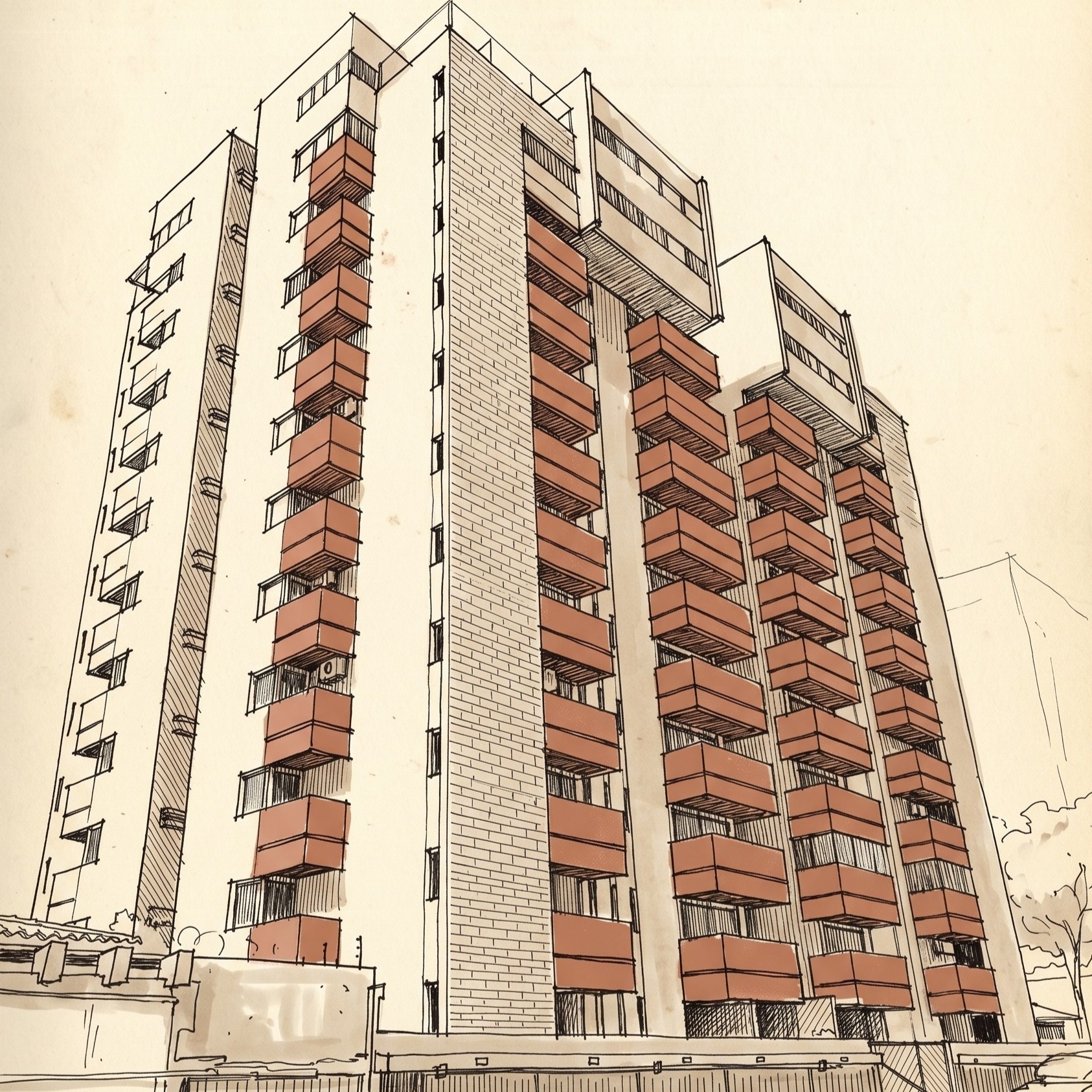
This article investigates the relationships between materiality, volumetry, and architectural identity in multifamily buildings, using as a case study the architectural production of Teresina, Piauí, across four phases of high-rise development, from 1969 to 2024. We compare eight representative buildings from Teresina with three paradigmatic examples from other Brazilian cities and examine how material and volumetric elements express architectural identities and respond to specific sociocultural, climatic, and market contexts. We combine documentary analysis, direct observation, and critical interpretation, applying a framework built from the concepts of critical regionalism, phenomenology, and tectonics. The results reveal a trajectory that starts from a brutalist modern expression, moves through phases of greater market appeal, with formal fragmentation and material diversification, and reaches a globalized contemporary language, with weaker regional connection. The comparative examples, especially those from Recife, show a more consistent search for a modern regional identity.
Downloads
References
BAPER, S. Y. Can architectural identity be measured? Buildings, v. 14, n. 5, p. 1379, 2024. Disponível em: https://doi.org/10.3390/buildings14051379.
BASTOS, M. A. J.; ZEIN, R. V. Brasil: arquiteturas após 1950. São Paulo: Perspectiva, 2010.
CAVALCANTI, L. Quando o Brasil era moderno: guia de arquitetura 1928-1960. Rio de Janeiro: Aeroplano, 2001.
CHING, F. D. K. Arquitetura: forma, espaço e ordem. 4. ed. São Paulo: Martins Fontes, 2016.
DIAS, José Ricardo de Freitas. Morar Apartado: um estudo sobre as transformações programáticas e espaciais dos edifícios de apartamentos em Teresina. 2001. Dissertação (Mestrado em Desenvolvimento Urbano) – Universidade Federal de Pernambuco, Recife, 2001.
FAÇANHA, A. C. A evolução urbana de Teresina: agentes, processos e formas espaciais da cidade. Dissertação (Mestrado em Geografia), Universidade Federal de Pernambuco, Recife, 1998.
FRAMPTON, K. Towards a critical regionalism: six points for an architecture of resistance. In: FOSTER, H. (org.). The anti-aesthetic: essays on postmodern culture. Port Townsend: Bay Press, 1983. p. 16-30.
FRAMPTON, K. Studies in tectonic culture: the poetics of construction in nineteenth and twentieth century architecture. Cambridge: MIT Press, 1995.
HAMID, M.; HANKS, L.; QI, W. Is it possible to define architectural identity more objectively? In: MOHAREB, N. et al. (org.). Cities' vocabularies: the influences and formations. Cham: Springer, 2021. p. 87-98.
HOLL, S. Questions of perception: phenomenology of architecture. San Francisco: William Stout, 2006.
MONTANER, J. M. Depois do movimento moderno: arquitetura da segunda metade do século XX. Barcelona: Gustavo Gili, 2001.
NORBERG-SCHULZ, C. Genius loci: towards a phenomenology of architecture. Nova York: Rizzoli, 1980.
PALLASMAA, J. Os olhos da pele: a arquitetura e os sentidos. Porto Alegre: Bookman, 2011.
SEGAWA, H. Arquiteturas no Brasil, 1900-1990. São Paulo: Edusp, 2014.
VILLA, S. B. Apartamento metropolitano: habitações e modos de vida na cidade de São Paulo. Dissertação (Mestrado em Arquitetura e Urbanismo), Escola de Engenharia de São Carlos, Universidade de São Paulo, São Carlos, 2002.
Downloads
Published
How to Cite
Issue
Section
License
Copyright (c) 2026 José Ricardo Dias

This work is licensed under a Creative Commons Attribution-NonCommercial-NoDerivatives 4.0 International License.
Authors who publish in this journal agree to the following terms:
1. Authors retain the copyright and grant the journal the right of first publication, with the article simultaneously licensed under the Creative Commons Attribution License BY NC ND, which allows the sharing of article with acknowledgment of authorship and initial publication in this journal;
2. Authors are authorized to take additional contracts separately, for non-exclusive distribution of version of the article published in this journal (e.g. publish in institutional repository or as a book chapter), with acknowledgment of authorship and initial publication in this journal;
3. Authors are allowed and encouraged to publish and distribute their research work online (e.g. in institutional repositories or on their personal page) once the editorial process has been completed, as this can generate productive changes, as well as increase the impact and the citation of published article (See The Effect of Open Access);
4. It is not recommended to publish and distribute the article before its publication, as this may interfere with its blind peer review.